Ongoing Public Funded R&D Projects
Safe Multicopter for Reliable Aviation

The FFG project Safe Multicopter for Reliable Aviation, in short SAMURAI, contributes to the fail-safe and resource-efficient operation of UAVs by developing an easy certifiable reference design with established development flow and verification processes. A load-optimized Y-shaped hexacopter (redundant propulsion system) with a maximum take-off mass of up to 25kg and advanced features to ensure robustness and safety during operation (e.g., advanced health measurements of the propulsion system, redundant flight controls, ...) serves as a reference for reliable high-performance multi-rotor platforms.
more
The goal of the project Stadt Wien Kompetenzteam für Drohnentechnik in der Fachhochschulausbildung (i.e., Drone Technology in UAS education) is to integrate
a selection of technologies that make uncrewed air and ground vehicles (UAV and UGV) – i.e., drones – possible into courses and lectures as the University of Applied Sciences Technikum Wien, thereby boosting student engagement.
In the course of the project, engaging exercises, lecture units, workshops, demonstrators, as well as bachelor's and master's projects in the field of drone technology are developed.
Furthermore, applied research in the context of the project is conducted.
more

The project Inclusion International combines the fields of action
"internationalization" and "e-Inclusion” (support of people with
disabilities through modern information and communication technologies).
Through the development and implementation of targeted measures, the
project addresses current challenges of the Internationalization
Strategy 2025 of the UAS Technikum Wien – in particular the increase of
student and staff mobility, the provision of new internationalization
activities for different faculties and study programs as well as the
intensification of cooperation with international partner universities.
more
Finished Public Funded R&D Projects
MEASURE

The project MEASURE (Monitoring Exercises using Ai-SUpport for Reliable Evaluation) examines
the applicability of artificial intelligence as well as multi-dimensional analysis
of sensor signals (such as position, movement etc.) to establish valid and swiftly
available evaluation results for emergency exercises. Besides technical feasibility,
the focus of the project lies on usability requirements for first responder
evaluators and legal-ethical circumstances, which have been researched little yet.
more

The goal of the project UGV-ABC is to develop a new type of mobile first response CBRN laboratory. For this a new type of
aggregation state agnostic sampling device is developed for the Taurob Ogrip Unmanned Ground Vehicle
(UGV) platform. Robotics and automation challenges of sampling are tackled jointly with the
Department of Industrial Engineering. The Department of Electronics Engineering focus is to validate and
implement the sensor choices for onboard analysis, e.g., RAMAN spectrometer, multispectral camera,
and gamma camera.
more
The aim of the "knowledge hub for accessible technologies" is to
foster the use of accessible technologies and thereby contribute to an
inclusive society. In an intermediary role between companies, research
institutes, care providers and users ("need-knowers"), the knowledge
hub creates awareness of the possibilities and benefits of assistive
technologies (AT), active assisted living (AAL) and accessibility of
digital information. Company partners are supported in the
barrier-free design of their products and workplaces as well as the
development of new target groups. In addition, new solutions are
developed in small projects - for example, to support a specific
person with computer access or to implement a concept for a
barrier-free company homepage. The project "knowledge hub for
accessible technologies" is partly funded by the city of Vienna (MA23).

In the Josef Ressel Center INES (Innovative Platforms for Electronic-Based Systems) the Research Group Embedded Systems
aims to address hot topics in the area of FPGA (Field-Programmable Gate Array) design.
Applied research questions related to FPGAs, like Design Space Exploration, Hardware/Software Co-design, High-Level Synthesis,
High-Performance Computing or Fault-Tolerant Design will be investigated in several application fields
and in cooperation with three industry partners.
more

The project ESprESSO-IT started on March 1st, 2018. The objective is
to enforce awareness for safety and security in software from the very
beginning of learning how to program. In order not to increase the total
effort put in by the students, tools for automated feedback are to be
incorporated. Those tools shall also keep permanent awareness for safety
and security issues in the students code. Furthermore, a set of
guidelines — dos and don'ts — is to be built.
more

The project "StudyATHome Internationally - International Teaching Setup for Students in Assistive Technologies and Smart Homes"
aims to develop and implement an international teaching setup for students in Assistive Technologies (AT) and Smart
Homes (SH) for people which are less mobile due to job, family or
disability. This can be part-time students but also full-time students
with a job, family or disability. Secondly, the courses of the faculty
should be more attractive to incoming students of partner universities.
Finally, the accessibility of the courses should be improved.
more

The aim of project AutoHoneyI(I)oT is to a framework that automatically
creates target device tailored honeypots for the (Industrial) Internet
of Things which are capable of convincing an adversary that she actually
breached a real device instead of a decoy.
The project "AutoHoneyI(I)oT" is partly funded by the FFG.
more
The project FPGA 4.0 deals with security issues and analog aspects of Field-Programmable Gate Arrays which are
sophisticated microelectronic components that today can be found in a multitude of applications. That way, the
Research Group Embedded Systems tries to maintain and extend know-how in the area of hardware platforms for today's and future
embedded and cyber-physical systems.
more

This research cooperation named SyCtrl (Sylents Controller – Predictive Maintenance of BLDC Motors) between the company Sylents and the UAS Technikum
Wien is focused on research topics in the field of predictive
maintenance of electronic BLDC motors. Sylents utilizes the BLDC motors
for green drives of water vehicles. In order to reduce and predict
severe maintenance periods of the electronic drive predictive
maintenance concepts will be implemented and applied to a prototype
demonstrator.
Project ISaFe pursues a novel approach based on binary rewriting to retrofit already existing IoT systems with security featurs in order to make them more resilient against unauthorized access attempts.
The project "ISaFe" is partly funded by the FFG.
more

Smart Homes and Assistive Technologies are tailored towards interoperable electronic products
operating in the immediate (living-) environment of people, to enhance their quality of life.
Utilization of Information and Communication Technologies (ICT) and Embedded Systems is a
key aspect of Smart Homes and modern assistive tools. In course of the ToRaDes project
(Toolbox for Rapid Design of Smart Homes and Assistive Technologies), resources and infrastructure
for easy application and adaptation of modern building automation solutions
and assistive technology for people with disabilities are developed and applied
in academic teaching at the UAS Technikum Wien.
more

The aim of project DIScoVER is to provide teaching material, course concepts, as well as hardware and software demonstrators for an industry ready education in the field connected embedded systems
more
The goal of the project iPlat ("Innovative Platforms for Mixed-Hardware/Software Systems")
is to foster educational activities in the area of hardware/software co-design and verification at the
University of Applied Sciences Technikum Wien and to increase the visibility of microelectronic systems in general.
more
The project OpenLab (an acronym for "Open Laboratory") deals with the development of dedicated lecture notes, demo examples, open source measurement equipment, scripts and other course materials as well as prototype and test environments, in order to provide students low-cost, powerful measurement equipment.
more

The project assistiVe domoTics for Autonomous living deals with the developement of technologies to support daily
live activities of elderly and disabled persons. Within the project assistive domitics with special focus on smart homes, e-health
as well as assistive robotics will be integrated into a safe and secure platform.
more

The aim of the project ULEA is build up of competence as well as the set-up of a laboratory for experimenting and training with e-mobility systems and assistive technologies. Furthermore a semi autonomous wheelchair demonstrator system is built by combining commercially of the shelf e-mobility components.
more

In the project Software Analysis Toolbox we adapt and develop tools to support teaching of Embedded Systems Software.
In the project we will use synergies with the Josef Ressel Center for Verification of Embedded Computing Systems to adapt test and verification tools and complement these with suitable tools for the development process.
more

The Josef Ressel Center for Verification of Embedded Computing Systems makes
state-of-the-art verification technologies industrial applicable and investigates
new technologies, tools, and methods. In particular, we will develop a flexible
runtime unit that will facilitate testing and functional checks when the system is operational.
Along with the partners Bluetechnix GmbH, Infineon Technologies Austria AG,
Kapsch TrafficCom AG, Loytec electronics GmbH, and Siemens AG Österreich we
will focus on dedicated aspects of their verification process in order to improve
the reliability of their products.
more

Prosperity4All (P4A) aims at creating a Global Public Inclusive Infrastructure (GPII) for the development of universal,
auto-personalized accessible interfaces. That will allow a new ecosystem to develop where cross-platform techniques, crowdsourcing and
gamification enable new strategies for the delivery of accessibility services, enabling an entirely new approach to accessibility
solution development; P4A is a large scale Integrated Project (IP) funded by the European Comission in course of the 7th framework program (FP7).
more

The "AsTeRICS Academy for Cross-Cultural Education and Research in
Assistive Technologies" (AsTeRICS-Academy) is devoted to the
international research cooperation in the field of Assistive
Technologies and to the strong reflection of these topics in the
curriculum of the University of Applied Sciences (UAS) Technikum Wien.
The various aspects of assistive technologies include autonomy and
comfort in the Smart Home (Ambient Assisted Living, AAL), the accessible
design of Web pages and user interfaces (Accessible Design,
Design-For-All) and the provision of assistance to people with physical
or mental disabilities by special devices. An essential task of the
AsTeRICS-Academy is to bring international developments in these areas
into the academic and educational portfolio of the UAS Technikum Wien.
more

More than 50 flats for the elderly will be equipped with modular and standard compliant AAL
technology whereby the services consider the whole social environment of the user. The
majority of the flats already exist and will be upgraded under consideration of highest
efficiency by using modern wireless technologies.
For the buildings to be newly erected the integration of AAL technologies will be already
considered in the early planning phase to be as non-obtrusive and cost effective as possible.
The used technologies will be evaluated scientifically in terms of user acceptance, usability
and the benefits and acceptance for the care giver and its staff.
The aim is to create a reference implementation in a region and the exploit the results and
experiences to the public as well as to develop an economic model for further use.
more

The project TWASIC (an acronym for "Technikum Wien ASIC") aims to provide standard-cell based ASIC
(Application-specific Integrated Circuit) technology to students of the University of Applied Sciences Technikum Wien.
By developing dedicated lecture notes, demo examples, EDA tool flows, scripts and other course materials as well as
prototype and test environments, students of our university will be able to design their own microchips.
more

The demographic trend in industrial nations towards an aged population and a decline in birth rates requires new strategies to cope with the upcoming social
and economic challenges. Ambient Assistive Technologies can provide support to elderly or disabled persons, foster their autonomy and quality
of life and lower the cost of medical care.
The founded professorship expands the expertise of the institute to the sectors of supportive tools and smart home technologies, to better convey these topics in course of the
academic education.
more

The availability of the first fully integrated MEMS gyroscopes in 2002 enabled the developement
of small and lightweight navigation sensors. In combination with other sensors they are used in
such different areas like avionics, mobile robotics, sports or medicine. The objectives of the
endowed professorship "Embedded Control and Navigation" are to improve the know-how in the upcoming
field of navigation technology, to develop educational materials and showcase navigation systems
and to assist our different degree programmes in the education of students in this technology.
more
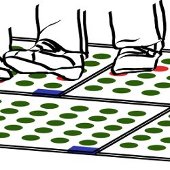
Real and accurate figures of the traffic patterns of individuals provide the basis for decision making and planning in public areas. The actual uses range from optimizing means of transportation over directing the flow of people (e.g. for commercial purposes) up to assess safety measures of events (e.g., festivals). FlexiCount investigates means to obtain such figures in an automated way using sensor-mats.
more

These days, the majority of embedded systems engineers still designing, programming, and verifying embedded software on
single-core embedded microcontrollers. As new technology trends emerge, more and more embedded chip vendors altering towards
multi-core technology, in terms of trying to provide sustainable performance enhancement by simultaneously lowering
chip power consumption.
Therefore, an embedded software designer, who is responsible for programming such new multi-core chips, are now facing new design challenges
due to the inherent parallelism of two or more cores running simultaneously.
more

AsTeRICS stands for "Assistive Technology Rapid Integration and Construction Set". In course of this international
Collaborative Project funded by the European Commission, flexible and affordable setups for user driven Assistive Technologies
dedicated to people with severely reduced motor skills will be developed and explored.
more

The objective of Competence Team Embedded Platforms is to extend the expertise of embedded
platforms and their application. This includes hardware, software, operating systems,
middleware, communication, networks, and distributed systems. Development tools like
Integrated Development Environments (IDEs), compilers, and debuggers are another major
concern.
more

The funded project AC-Centrope II pursues the development of a curriculum, lab infrastructure, and courses for E-Mobility.
The ERDF funded project is organized as a joint effort of Wirtschaftsagentur Wien,
the István Széchenyi University in Györ, Hungary, and
the University of Applied Sciences Technikum Wien.
more
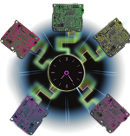
In the course of the research project COORDES a new, patented solution which enables coordinated test, debugging and diagnosis in distributed embedded systems is
realized using FPGA-based as well as MPW-based ASIC prototyping.
more
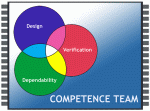
The competence team for test and verification of dependable systems investigates concepts and methods that will
enable testing and debugging of tightly coupled distributed embedded systems. Based on tight distributed clock synchronization
a first demonstrator shall enable, for example, investigation of distributed algorithms.
more
 Design Methods for Embedded Control Systems (DECS)
Relevant topics addressed by the DECS project are (i) formal specification and verification of embedded control system architectures and,
(ii) elaborate test and diagnosis tools for distributed embedded systems with a focus on automotive communication systems.
more
 Debugging of Real-Time Systems
The goal of the project is to develop strategies for debugging of real-time systems, which are used in today's networked
automotive systems using CAN, LIN or FlexRay. In addition, the project aims to transfer the findings and results to the department's undergraduate and graduate courses.
more
 Automotive Gateways
LIN, CAN, Byteflight, FlexRay, MOST are communication subsystems that are in use in modern cars.
These interconnect different electronic control units and enable thus the combination of various information that can be used to realize new features.
The research project Automotive Gateways investigates the complex network infrastructure in today's cars and tries
to find proper solutions on how to interconnect the various sub-systems.
more
 Component-based Automotive System Software (COMPASS)
Consortia like AUTOSAR push the standarization of the software in the automotive industry ahead.
The research project COMPASS investigates a component based approach, metrics,
and benchmarks to assess cost, performance and dependability aspects of such solutions.
more
 Systematic Test of Embedded Automotive Communication Systems (STEACS)
The vision of the STEACS project is to handle the automotive electronics complexity towards "Self-testing Cars".
To that end, this project will implement diagnosis and test tools based on requirements derived from the project partners.
more
Industrial Contracts
 Digital Signal Processing in MIMO and Dispersive Systems
The ongoing innovations in the field of MEMS technology enable additional use cases in growing and emerging areas such as healthcare,
automatic manufacturing, and predictive maintainance. The research cooperation between Infineon Technologies Austria AG and the
UAS Technikum Wien focuses on developing a prototype to evaluate the potential of MEMS-based microphones for detecting sub-millimeter
movements. This includes experimental software modules that further process the data provided by multiple MEMS microphones, based on multicore
microcontrollers (Tricore Aurix family). To evaluate the feasibility and capabilities of such a system, all modules will be combined
into a demonstrator capable of non-contact pulse measurement.
Emerging Applications Lab on Software Development for Unmanned Aerial Vehicles (UAVs) based on Multicore Microcontrollers
This research cooperation between the company Infineon Technologies Austria AG and the UAS Technikum Wien is focused on research topics in the
field of aviation. Specifically, the UAS Technikum Wien develops experimental software modules for Unmanned Arial Vehicles (UAVs) based
on a multicore microcontroller
(Tricore Aurix-2G),
which is widely used in the automotive industry. Various companies (Airbus, Boeing etc.) focus on research and development in the field
of autonomous aviation. Within this field of application aviation safety plays a major role. Currently, there are no security standards
for aviation safety existent. Therefore, adequate
physical demonstrators
are mandatory to check the plausibility of future aviation safety standards and to test and implement them.
 Research Cooperation between Elektrobit and UAS Technikum Wien
This reserach cooperation between the company Elektrobit Austria GmbH and the UAS Technikum Wien is focused on the adaptive AUTOSAR stack
ARA::COM.
The students side of the mutual benefit is insight into an actual topic of high industry relevance and the possibility of doing
theses or specialization groups in this context.
 Development of an Audio-Recorder Prototype for Smartphones
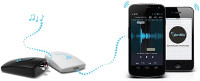
In this project we developed a high-fidelity stereo audio-recorder prototype for smartphones. The respective prototype was developed as an acessory for Android and iOS devices. The contractor is Thomas Buchstätter an entrepreneur and employee of play.fm. The project received funding by the Austrian Research Promotion Agency FFG.
 Engineering support in the context of the Eurocontrol project SESAR
In this project the Research Group Embedded Systems offers design and engineering know-how to Frequentis in the context of the Eurocontrol funded
project SESAR as a subcontractor.
 MDEBox - A Wireless Network Module to connect production machinery
In this project we develop a wirless module that interconnects various production machines (CNC, lathes, etc.) in order to collect status
information and the number of pieces every machine produces.
 Modbus - Dynamic Route Information Panel Gateway
In this project we ported a SiTOS implementation to the Modbus bus protocol for a dynamic route information panel.
Furthermore, we enhanced the functionality of the software to accomodate displaying of multiple independet texts in different language locales.
 Implementation of a coordinated firmware update solution via JTAG
In this contract the Research Group Embedded Systems develops a coordinated firmware update solution based on IEEE 1149.1 JTAG.
The software makes use of Standard Vector Format files and distributed test and debug services.

In the context of this contract the Research Group Embedded Systems offers design, implementation and test services for
FPGA and ASIC designs relying on Ethernet and IEEE 1588 clock synchronization.

- Programmable Logic Devices (PLD, FPGA Technologies)
- Synchronous Design Methodologies
- VHDL for Combinational & Sequential Logic
- VHDL Signals, Variables and Datatypes
- Theory and Application of Finite State Machines
 Design and Verification Support for a Distributed Real-time System
Engineering support for the design and verification of the distributed hardware/software for the
measurement products DIS and VIS. In particular, hardware and software review as well as courses
to transfer know-how to improve the concepts of the respective products.
In this project a gateway for a traffic management system was developed that allows to display route-information via suitable information panels.
The solution is based on a PC/104 platform running the SiTOS protocol.
Engineering Support for Hardware/Software Co-Design
In this cooperation with the company Oregano Systems the Research Group Embedded Systems provides engineering support for hardware/software co-design.
 Test und Diagnosis of a FlexRay EPL Sub-System
The aim of this project is to define and implement test and diagnosis scenarios for bit error rate observations at the interface
level which connects a FlexRay communication controller to the transceiver circuitry.
more
 Development of a Data Collection Platform (DCP)
In the context of this project the Research Group Embedded Systems is developing a satellite modem aka. data collection platform (DCP) for the company Logotronic GmbH.
With the help of a data logger observations and measurements of the physical, chemical or biological properties of oceans, rivers,
lakes, solid earth and the atmosphere are obtained. The DCP interfaces to this data logger and relays the collected data via METEOSAT or GOES satellites to
dedicated ground stations.
more